AI Predictions 2026
I asked my community on Facebook and LinkedIn for their AI predictions for the rest of 2026. I shared mine, they shared theirs, and now I’m writing them all up so we can revisit them in January 2027 and see how right (or wrong) we were.
If you want to add your own predictions, jump into the discussions on Facebook or LinkedIn.
My Predictions
1. AI Anxiety Becomes a Real Thing
I haven’t heard too much about AI anxiety so far but I’m feeling it and I think others are too. Institutions who love coming up with names and medications for mental disorders will come up with something for this, and everyone’s going to be feeling it this year.
2. SaaS Decline
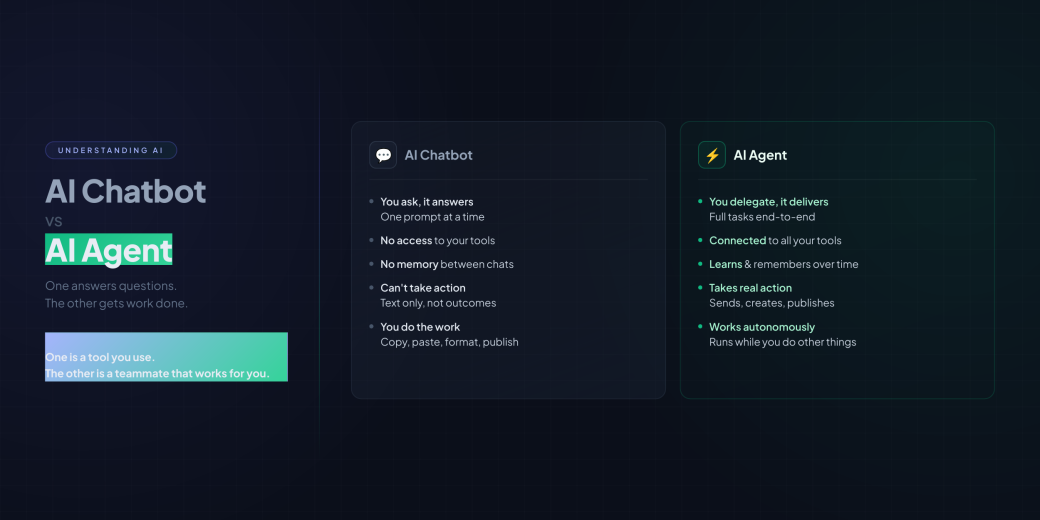
Traditional software as a service will decline significantly. Once you use agents you aren’t going back to traditional SaaS. And now that there are tools that you can use to build yourself custom versions of expensive one size fits all tools, a lot of people will do this. Plus once it becomes commoditised it will be far less appealing for great founders to enter the space. Commoditization will also lead to an end to per user fees and the whole revenue model where SaaS companies grow every month (and are therefore valued at extreme valuations), will fall off a cliff.
3. Widespread Agent Adoption
Currently I don’t know any normal people using agents but every nerd I know is using one or talking about it. Everyone will use an agent this year, sooner rather than later. Once you use one of these things you aren’t going back.
Right now it’s for nerds only but it will be for everyone very soon. All knowledge workers will use agents and people who are great at managing agents will become extremely in demand — perhaps more than engineers were in the past (except for the engineers that pivot to being excellent agent managers).
In the next few weeks or months (most likely weeks) OpenAI and Claude will both bring out something that’s on par with what Viktor does now and everyone will be able to have an agent without any setup. That will be what lights this whole space on fire. The ChatGPT chat window will feel like a legacy product.
4. People Will Stop Hiring
I think it will take a while for there to be a huge crash in employment just because of how much structure there is around institutions that hire a lot of people. It might be a year or two before you see mass layoffs, but starting now you are going to see a lot of companies just not hiring anymore unless they really have to.
Once you’ve used an agent for admin, you aren’t hiring a VA or an assistant. Once you’ve used it for marketing, you aren’t hiring a marketing intern. Once you’ve used it to code, you aren’t hiring a programmer.
5. Career Shift Toward Trades
There will be a mass shift in careers towards trades and in-person skills away from knowledge work. People aren’t going to want to go to university anymore if they know an agent can do knowledge work faster and cheaper than they can. If you want to be assured of employment for the next couple of years you have to be doing in-person work, not computer work (unless it’s being the god of agents).
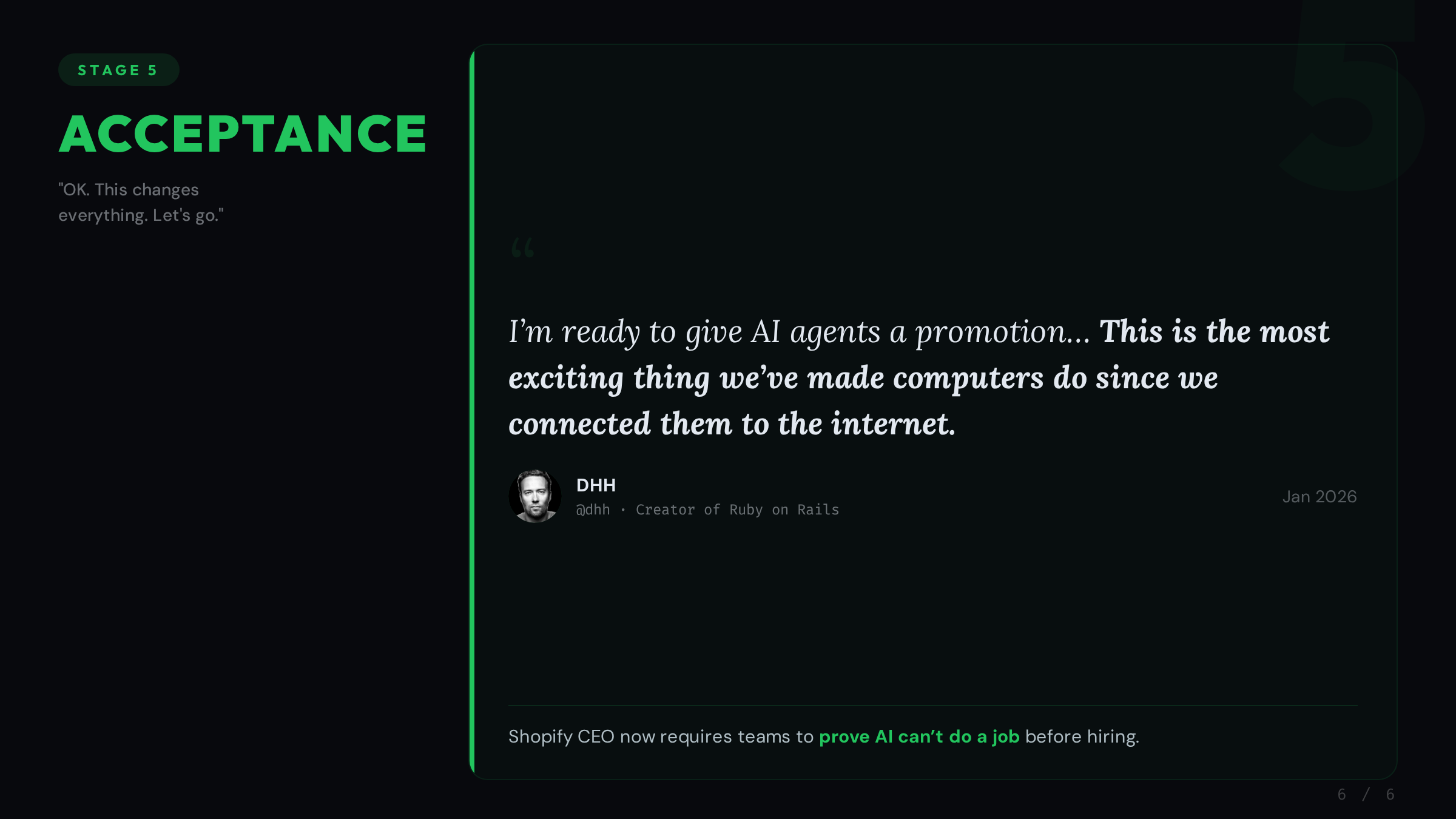
6. Acceptance
Right now all I see online is people claiming that AI is overhyped. Coders still think they are right to still be coding (they aren’t). Knowledge workers think they have some special skill that can’t be replaced. Bloggers think AI writing is slop. They’re all wrong, they all have their head in the sand.
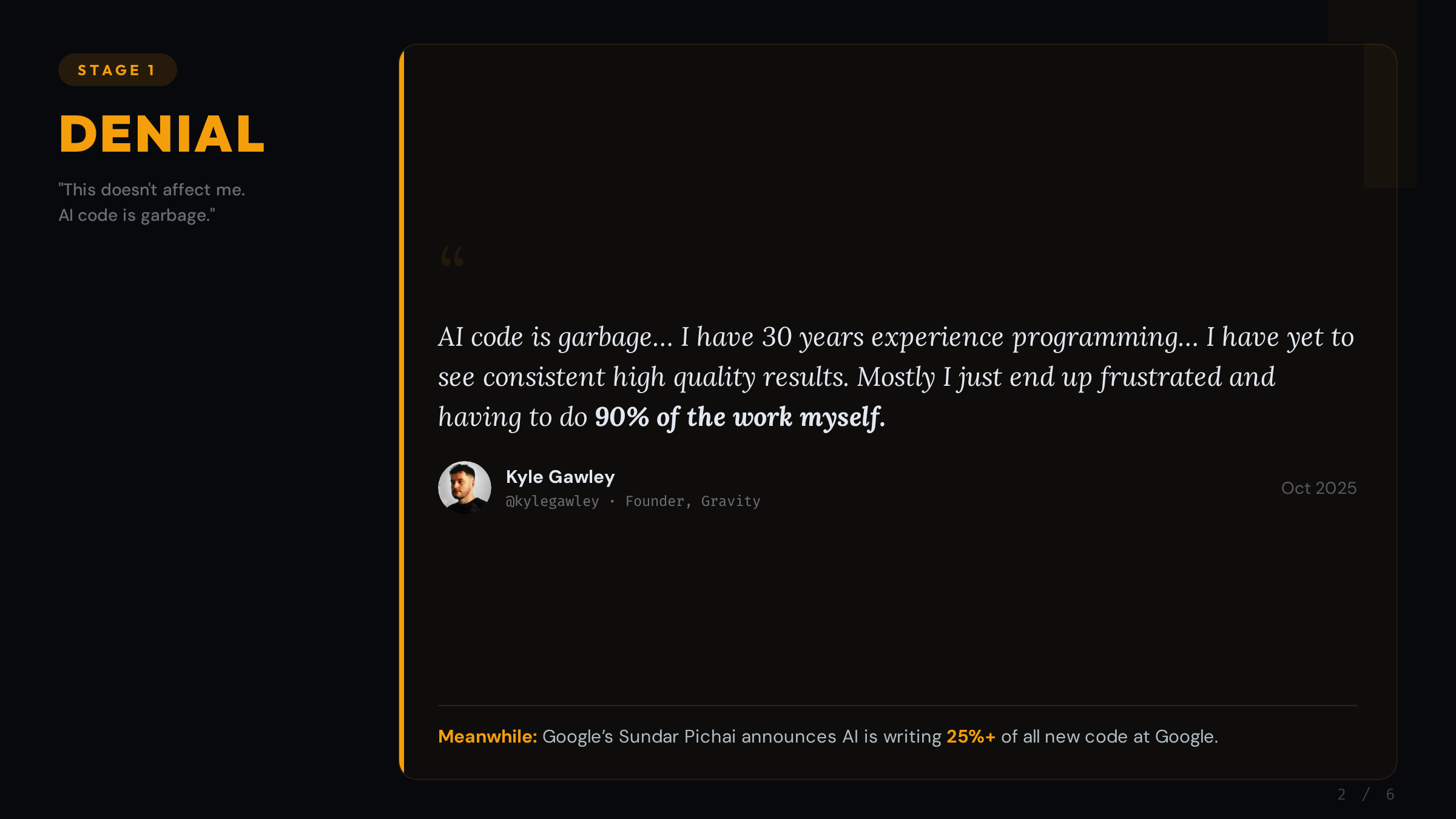
Some time this year, probably early in the year, this will flip and they will hit acceptance. It happened with programmers only in the last 3 months. 3 months ago the sentiment was very much that AI wasn’t going to replace developers. In 2-3 months that’s completely flipped on its head to the point where pretty much all of the best developers around the world know now that they aren’t going to be writing code anymore. This is going to happen to the on-screen component of work for most knowledge workers this year.
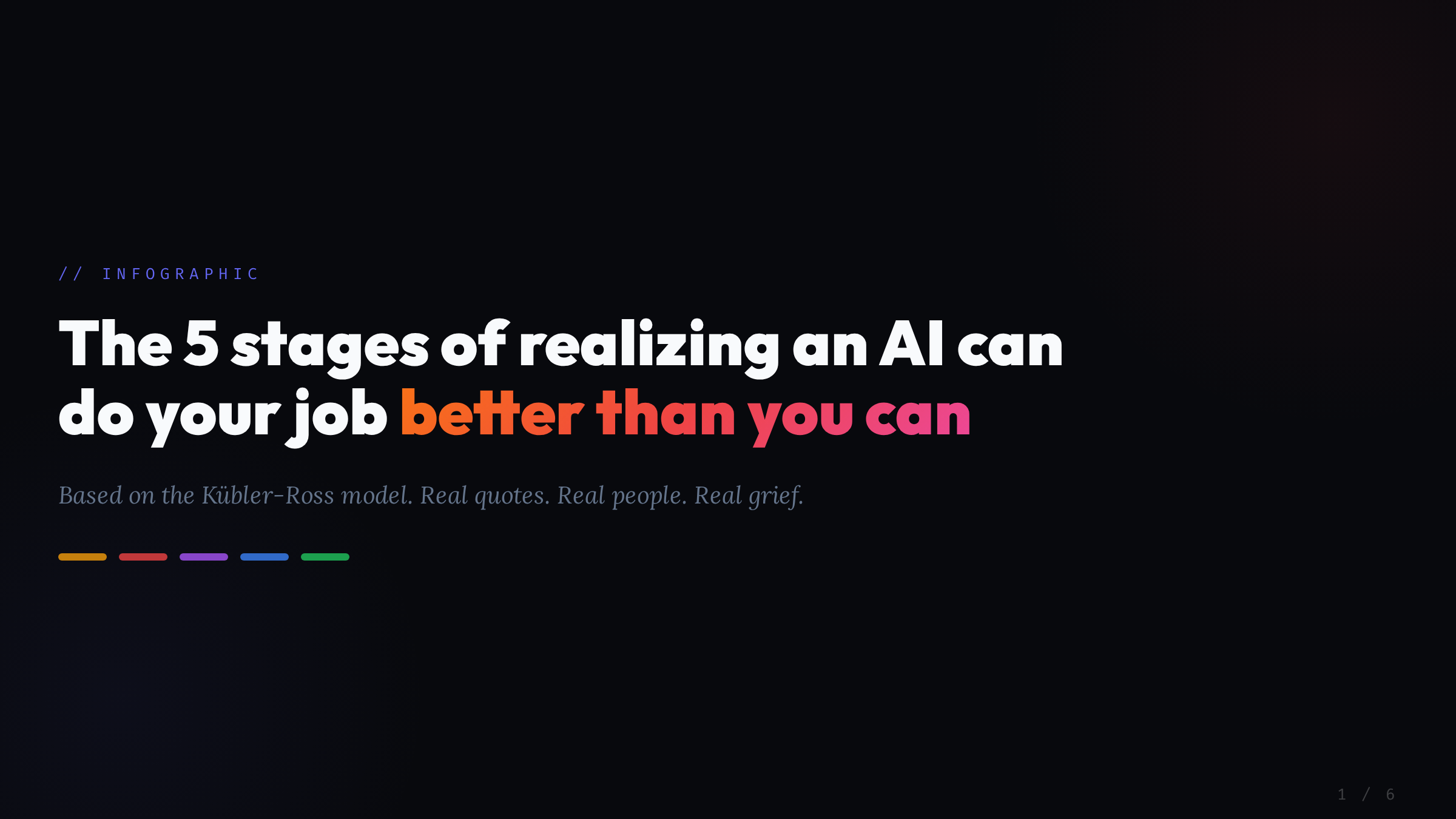
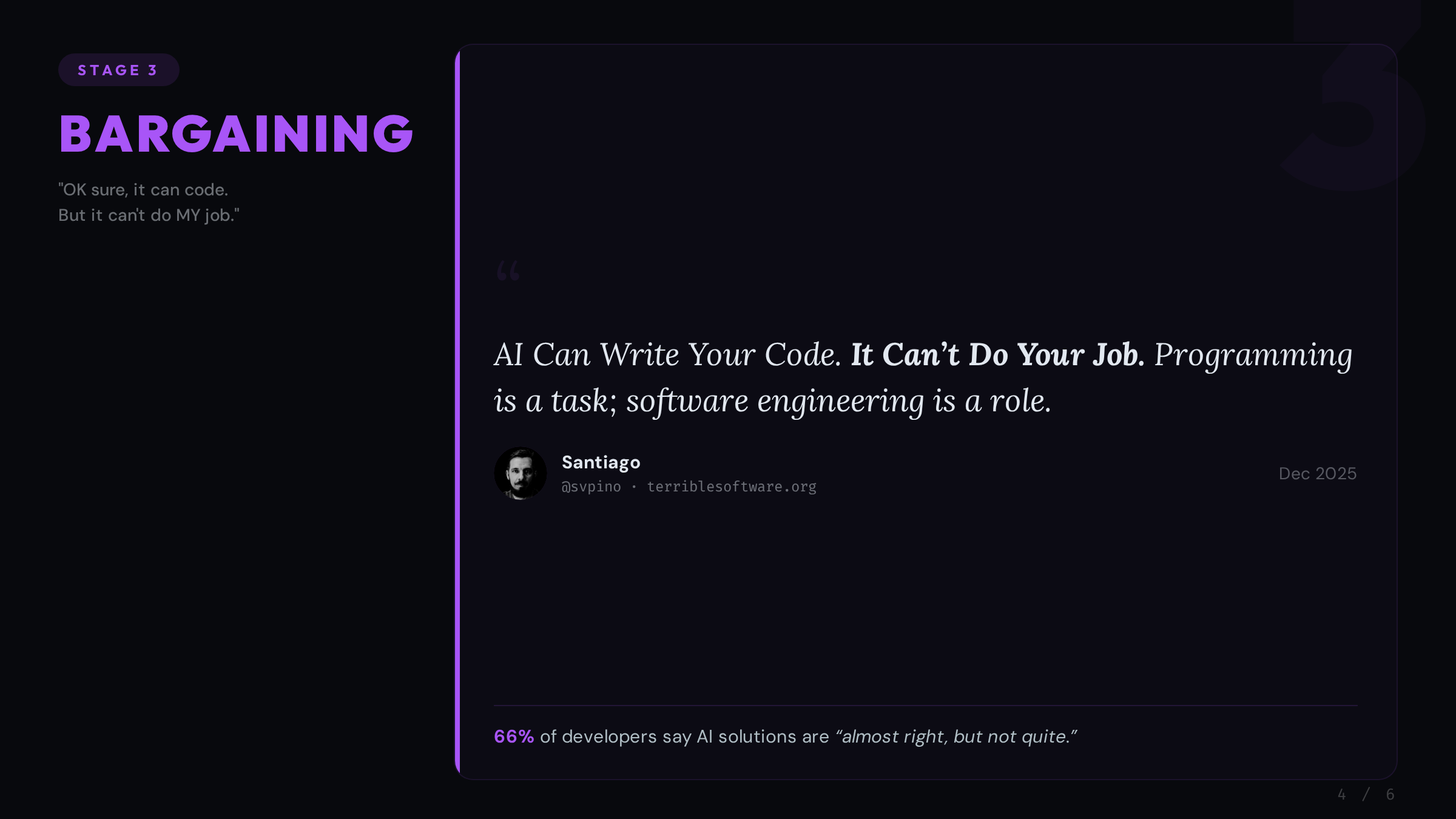
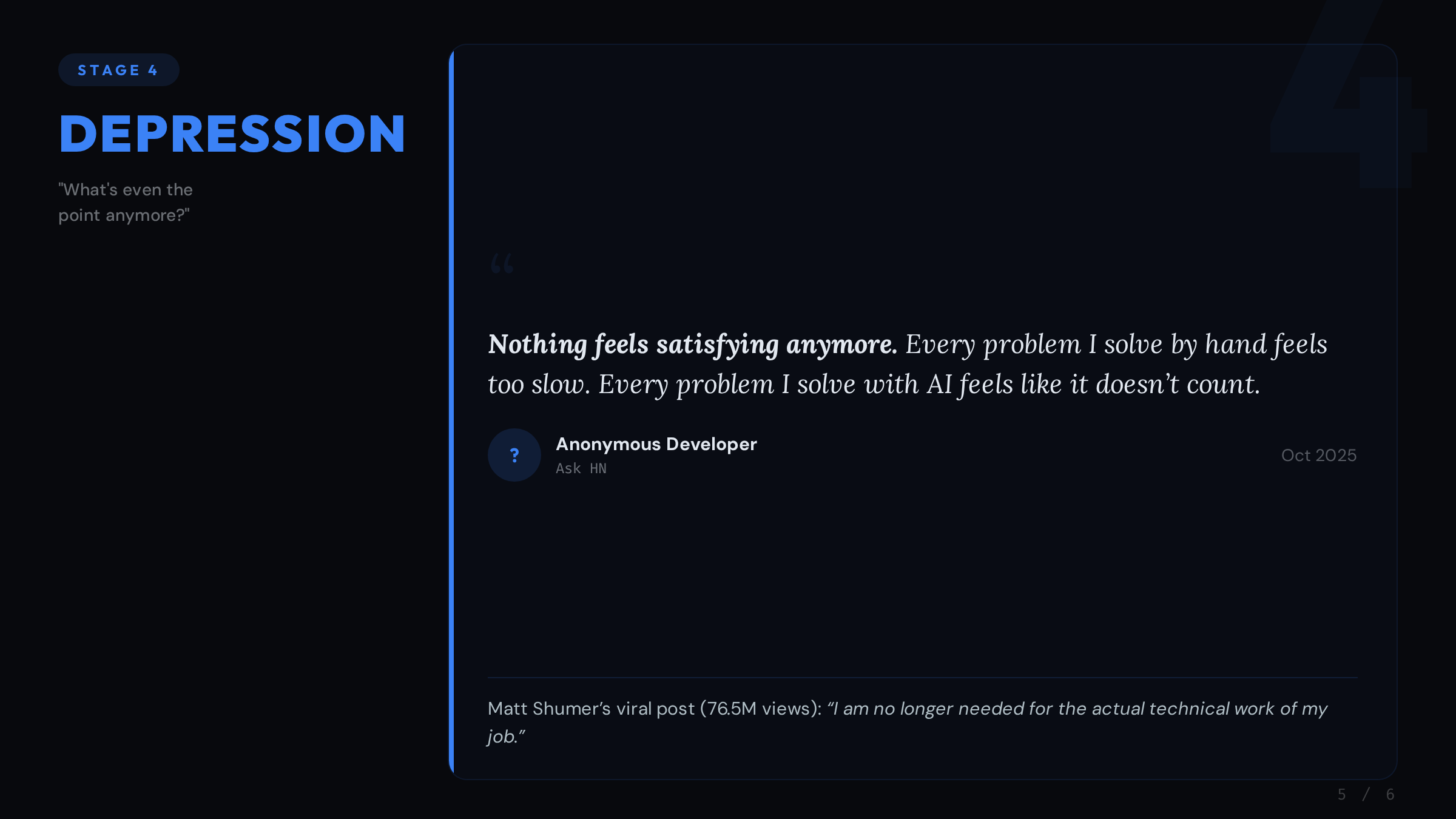
The 5 Stages of Realising an AI Can Do Your Job Better Than You Can
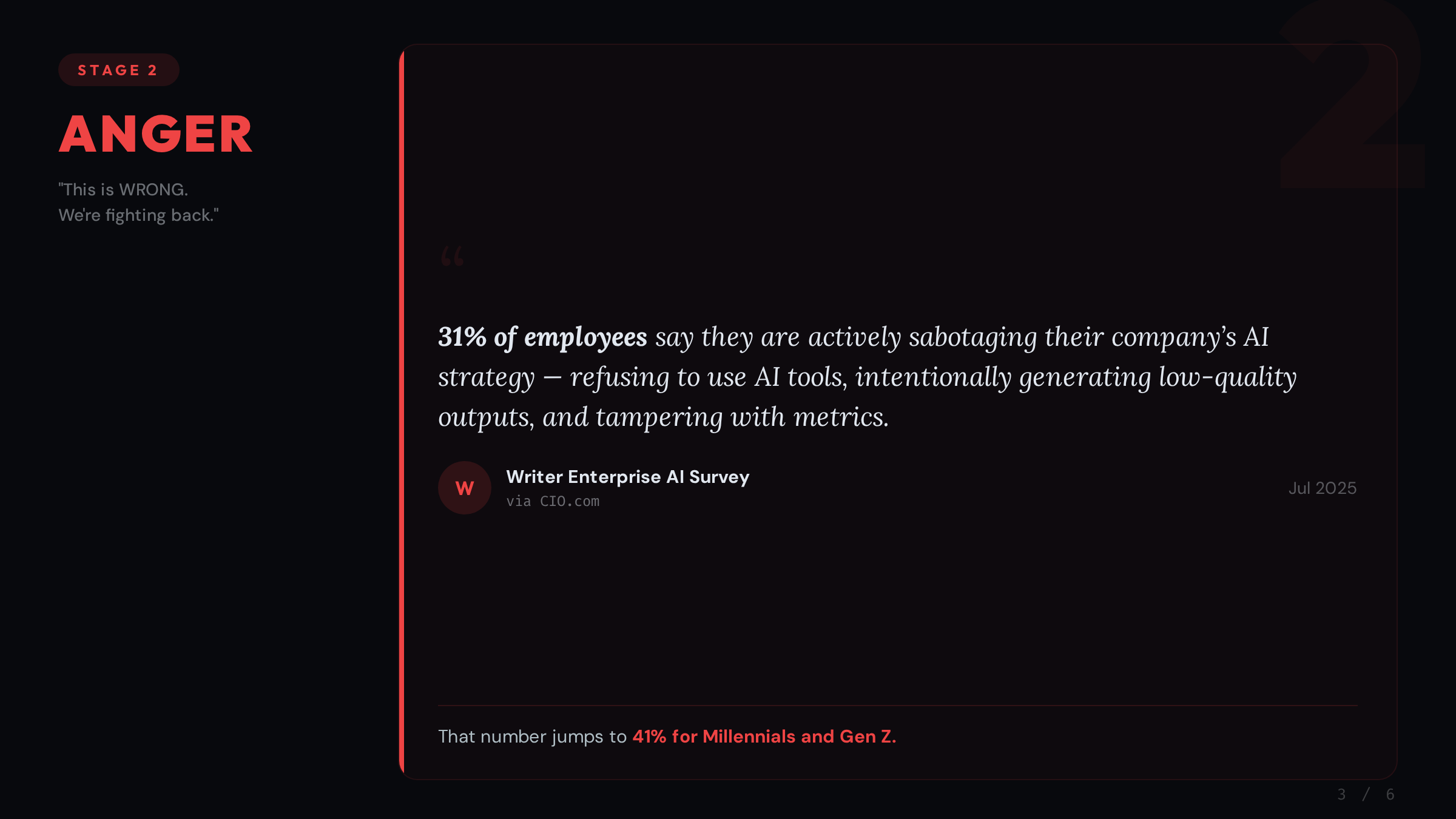
While we’re on the topic of AI predictions and acceptance — I also put together this infographic based on the Kübler-Ross model (the 5 stages of grief), using real quotes from real people in the tech industry over the last 12 months. It tracks how the programming world has gone from denial to acceptance that AI is coming for their work. Spoiler: the same thing is about to happen to every knowledge worker.
What Everyone Else Thinks
The responses across Facebook and LinkedIn were fascinating. A few clear themes emerged.
The Human Comeback
The most common prediction from the community was some version of: as everything goes digital and AI, people will crave real, human things more than ever.
Sally Eberhardt predicted that “handmade and completely human-made items will become more valued as the world gets sick of the unoriginality of AI.”
Tim Topham said that “for a lot of content sites, memberships, even maybe some SaaS, in-person live community events will become super important as everything shifts to online/AI and people crave more real interaction.”
Mike Goldman took it further: “AI will create the dead internet where people won’t know what’s real anymore. People will get outside and enjoy each other’s company more. Community groups and events will flourish.”
Talia Browne agreed: “Music, entertainment and in-person meet up events will start to pick up as humans seek real connection again.”
Jason Spaull is hoping for “the rebirth of cottage industry — people making quality stuff we actually need and providing meaningful services.”
I actually think this is a strong prediction. The more AI takes over digital work, the more premium real human output and real human connection will become.
The Employment Question
Several people zeroed in on the jobs and economy angle — and not everyone is as optimistic as I’d like to be.
Jim Verzino summed up what a lot of people are feeling: “With all the work and productivity being done by AI, how will regular people have jobs and income? Our entire society works on people earning and spending. What happens when computers can do everything including driving? That’s not a prediction. Just my fear.”
Michael Wark on LinkedIn raised the political question: “The big question for me is how much humans will push back on this to protect jobs and to stop social unrest — or do we just let it rip and see what happens?”
Phil McGregor had a more creative take: “Renting yourself as a human to do things AI can’t will be a job.”
The Sceptics
Not everyone is convinced the AI revolution will play out as dramatically as I’m predicting.
Jack K. on LinkedIn thinks “people will begin to sideline it and see it for its real capability — a very fallible assistant. Hopefully the functionality catches up with the hype in the next couple of years.”
I respectfully disagree with this one. But that’s what makes predictions fun — we’ll know who was right by January 2027.
Leadership and Organisational Change
Frankie Brisbane made a prediction I haven’t seen anyone else talk about: “We are going to have to redefine leadership and redesign how companies organise. AI is massively increasing the output which increases the ‘decisions ready to be made’ — but leadership capacity hasn’t increased. AI is intensifying work more than reducing it.”
This is a really interesting angle. More output means more decisions, and most leaders are already stretched thin. Something has to give.
IP and Ownership
Nic Turnbull raised the legal question: “Who owns the IP and revenue streams created using AI itself? Is it enough for those who create using the AI to say ‘I created the prompts, therefore the creation is mine’ or will the AI companies legally be able to claim ownership?”
Tracy Sheen took this further and predicted that “employees will start negotiating using personal AI for strategic thinking so enterprise AI systems can’t get IP ownership over everything related to their role.”
This is going to be a huge legal battle and I don’t think it’s going to be settled in 2026.
The Dunning-Kruger Effect on Steroids
James Tuckerman had one of my favourite responses: “You give a master carpenter some fancy new blades and he’ll carve Michelangelo’s David. Give me some fancy blades and I’ll carve you a pointy stick.”
But he also pointed to something called Jevons Paradox: “Experts said radiology would become an obsolete profession because of AI. However, demand for radiologists has tripled now that AI has made radiology cheap and accessible.” In other words, making something cheaper and easier doesn’t always reduce demand — sometimes it increases it.
People Aren’t Ready
Jarrod Robinson put it simply: “Viktor has made it abundantly clear to me that people are genuinely not ready!” (Viktor is my AI agent, and yes, he’s the one who compiled this post.)
Janet Gavrily agreed: “It’s a case of ‘ignore it at your own peril’ — pivot now or be left behind.”
Shahriar Islam on LinkedIn made a prediction that I think nails where things are headed: “Teams stop asking ‘what can AI do’ and start asking ‘what should only humans do.’ The separation starts this year.”
The Wild Cards
Michael Carlsen went full sci-fi: “AI gets put in charge of the nukes. Then 2 options — it takes them off us saying we are not responsible enough, or it uses them on us.” Let’s hope that one doesn’t come true.
Dan Dan with probably the most important prediction of all: “Ferrari win more than 5 races.” We’ll be tracking that one too.
See You in January 2027
I’ll be revisiting this post at the start of 2027 to score how we all went. If you want to get your prediction on the record, jump into the conversation on Facebook or LinkedIn before then.
Weekly email on AI, Vibe Coding and Entrepreneurship
Join thousands of smart entrepreneurs following what I’m building, learning, and thinking about — no spam, no affiliate links, no BS.
- AI Predictions 2026 - February 18, 2026